
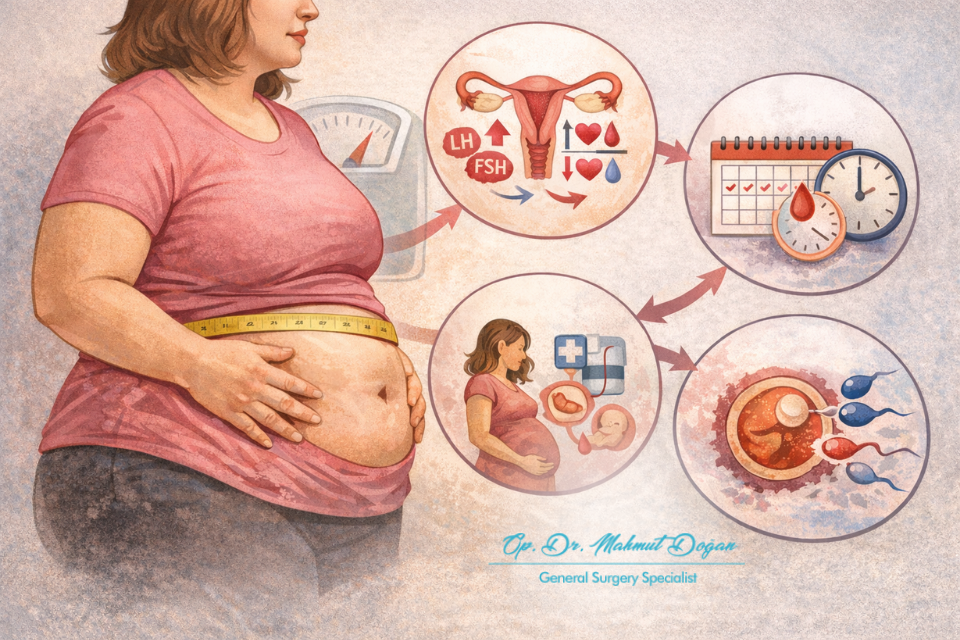
Excess weight negatively affects fertility in women by disrupting ovulation and menstrual regularity. The reason is that overweight women carry various risks due to hormonal imbalances, reducing their chances of conceiving naturally. In this article, these scientific findings will be explained in detail in a way that is easy for the public to understand and based on current data.
Effects of Obesity on Hormones and Ovulation
Excess adipose tissue in the body alters hormone production. The aromatase enzyme in fat tissue converts androgens into estrogen, increasing estrogen levels in the blood. High estrogen levels suppress the hypothalamic-pituitary-ovarian (HPO) axis; in other words, the GnRH and LH/FSH hormones that regulate ovulation in the brain are reduced.
On the other hand, obesity leads to excessive insulin production by the pancreas. High insulin levels increase androgen (male hormone) production in the ovaries. Increased androgen inhibits follicle development in the ovary. Thus, in obese women, insulin resistance and fat accumulation; combined with increased androgen and estrogen, lead to anovulation (lack of ovulation) and menstrual irregularities.
In one study, menstrual irregularities were detected in 30% of overweight women and 47% of obese women, and it was observed that even a weight loss of around 5–10% could restore ovulation.
Obesity and Polycystic Ovary Syndrome (PCOS)
PCOS is a common disorder characterized by irregular menstruation and hyperandrogenism. Obesity is also an important factor that increases the risk of PCOS. Research shows that most women with PCOS suffer from insulin resistance and excess weight. Compared to women of normal weight, overweight women respond less effectively to PCOS treatment. Reduced ovulation is more common. Obesity can both lead to PCOS and worsen reproductive problems when combined with existing PCOS.
Obesity and Fertility
Scientific data show that obese women have a lower chance of conceiving naturally. In a prospective study, a 4% decrease in pregnancy rates was observed for each unit increase in BMI (e.g., from 30 to 31). Similarly, excess weight is known to reduce success rates in treatments such as IVF/ICSI. In other words, obesity reduces the chances of achieving pregnancy both naturally and through assisted reproductive technologies (ART). The ASRM committee report also emphasizes that “Obesity impairs ovulation and menstrual function, natural fertility, and the success of infertility treatments.”
Impact on Assisted Reproductive Techniques
High BMI also creates obstacles in procedures such as in vitro fertilization. Obese women show resistance to ovulation-inducing medications. These patients also have a higher risk of miscarriage. It has been determined that obese women with PCOS require more hormones (gonadotropins) compared to women of normal weight and have lower live birth rates. Achieving target weight before IVF or losing weight through bariatric interventions is important.
Pregnancy Complications and Perinatal Risks
Obesity is a very dangerous disease for health even outside of pregnancy. During pregnancy, it increases serious risks affecting both mother and baby. Gestational diabetes and preeclampsia (pregnancy-induced hypertension) are common in overweight pregnant women. This increases the likelihood of preterm birth, unnecessary cesarean sections, macrosomia (large baby), and neonatal mortality. For example, according to one study, approximately 18% of pregnant women with a BMI around 36 (severe obesity) developed preeclampsia and 15% developed gestational diabetes. According to NICHD, obesity in pregnancy increases the risk of diabetes and hypertension, while also raising the risk of spinal and heart defects, large babies, and stillbirth.
Conclusion and Recommendations
In summary, obesity in women affects reproductive health in multiple ways. Changes in the hormonal system disrupt ovulation, cause menstrual irregularities, and reduce fertility. Weight control before pregnancy, lifestyle changes, and when necessary, medical/interventional support are critical to facilitate conception and reduce pregnancy risks. Scientific evidence shows that weight loss can improve ovulation function and increase the chances of pregnancy.
Sources
The Impact of Maternal Obesity on Maternal and Fetal Health - PMC
https://pmc.ncbi.nlm.nih.gov/articles/PMC2621047/
Who is at increased risk of health problems during pregnancy? | NICHD
https://www.nichd.nih.gov/health/topics/preconceptioncare/conditioninfo/risk
Obesity and reproduction: a committee opinion (2021) | ASRM
https://www.asrm.org/practice-guidance/practice-committee-documents/obesity-and-reproduction-a-committee-opinion-2021/
Risk of Adverse Pregnancy Outcomes by Prepregnancy Body Mass Index
https://pmc.ncbi.nlm.nih.gov/articles/PMC4285688/
13/06/2026 Obesity

06/06/2026 Obesity

04/06/2026 Obesity

15/05/2026 Obesity

09/05/2026 Obesity

02/05/2026 Obesity

25/04/2026 Obesity

18/04/2026 Obesity
Crafted with by

© Tüm hakları saklıdır.