
"No matter how little I eat, I can’t lose weight."
"I’m dieting and exercising, but the scale just won’t move."
"I gain weight very quickly, and I’m constantly tired."
Do these statements sound familiar?
The solution to excess weight is not always as simple as starting a diet and exercise program. Weight management is a far more complex process that depends heavily on hormonal balance. One of the key players in this process is the thyroid gland—a small, butterfly-shaped organ located at the front of the neck with a significant impact on the body's metabolism.
If your weight-loss journey has stalled, it is worth taking a closer look at the relationship between the thyroid gland and body weight before searching for answers elsewhere.
The Thyroid Gland and the Body's Metabolic Speed Control
The thyroid gland functions like the body's accelerator pedal. Through the hormones T3 (triiodothyronine) and T4 (thyroxine), it regulates the body's metabolic rate, or how quickly it uses energy. Medically, the Basal Metabolic Rate (BMR)—the amount of oxygen the body consumes while at rest—is directly influenced by thyroid hormone levels.
In hypothyroidism, commonly known as an underactive thyroid, the basal metabolic rate slows down, making it more difficult for the body to burn energy efficiently.
In hyperthyroidism, often referred to as an overactive thyroid, metabolism speeds up excessively, which may lead to unintentional weight loss.
However, current research shows that the relationship between body weight, energy balance, and metabolic rate involves far more than thyroid hormones alone. The system is governed by a complex network of factors. While the thyroid plays a major role, it is not the only determinant.
Does Hypothyroidism Really Cause Excess Fat Gain?
Many people who gain weight quickly assume that an underactive thyroid is the primary cause. While hypothyroidism can indeed slow metabolism and contribute to a weight gain of approximately 15–30% relative to a person's previous body weight, there is an important medical fact that is often overlooked.
Even in severe cases of hypothyroidism, most of the weight gain results not from excessive fat accumulation but from the body's retention of water and salt (edema).
For this reason, when patients begin thyroid hormone replacement therapy and their hormone levels return to normal, only the weight directly attributable to thyroid dysfunction—typically less than 4–5 kilograms (9–11 pounds)—is expected to be lost.
If your thyroid hormone levels have been normalized through treatment but you continue to gain weight, the issue is likely no longer related to thyroid disease itself. Instead, it may be associated with obesity, lifestyle factors, or broader metabolic processes.
The Body's Defense Mechanism During Dieting: Reduced T4-to-T3 Conversion
One of the biggest frustrations for people attempting to lose weight through strict dieting is reaching a plateau where weight loss suddenly stops.
This is actually one of the body's built-in survival mechanisms.
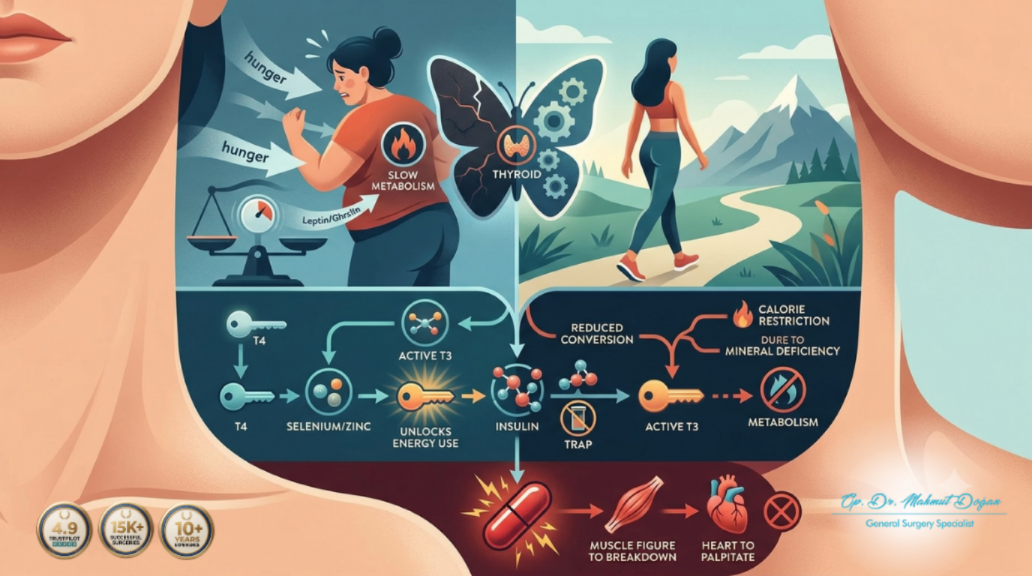
When calorie intake is reduced significantly—especially through overly restrictive diets—the body interprets this as a period of scarcity. In response, it decreases the conversion of inactive T4 hormone into active T3 hormone within cells.
As active T3 levels decline, metabolic rate slows down, making further weight loss increasingly difficult.
At the same time, leptin levels decrease. Leptin, a hormone produced by fat tissue, falls during calorie restriction. Lower leptin levels stimulate appetite centers in the brain, increasing hunger and making adherence to a diet more challenging.
Ghrelin levels increase. Ghrelin, often called the "hunger hormone," is produced in the stomach. During dieting, ghrelin levels rise, intensifying feelings of hunger and increasing the body's resistance to further weight loss.
Hidden Factors That Can Prevent Weight Loss: Minerals and Insulin
The conversion of T4 into active T3 depends not only on calorie intake but also on several essential nutrients.
People struggling to lose weight should consider evaluating the following:
1. Deficiencies in Selenium, Zinc, Iron, and Copper
These minerals play a direct role in converting T4 into T3. Selenium deficiency in particular can contribute to reduced thyroid activity at the tissue level and a slower metabolism.
2. Omega-3 Deficiency
Omega-3 fatty acids help improve the effectiveness and sensitivity of thyroid hormones within cells.
3. The Insulin Resistance Trap
In individuals with hypothyroidism, the slower metabolism can impair the body's ability to process carbohydrates efficiently.
As a result, the body may produce more insulin to control blood sugar levels. Elevated insulin can trigger; increased appetite, sudden cravings, irritability, fatigue, dizziness and strong sugar cravings.
These symptoms can make sustainable weight loss significantly more difficult.
Critical Warning: Never Use Thyroid Medication for Weight Loss
Some individuals who struggle to lose weight attempt to take additional thyroid hormone medications, such as levothyroxine, in hopes of accelerating fat loss.
This practice is extremely dangerous.
Excess thyroid hormone primarily causes muscle breakdown rather than targeted fat loss. Artificially inducing a hyperthyroid state can lead to; heart palpitations, severe nervousness and anxiety, muscle loss, metabolic complications, and, long-term health risks.
Most importantly, once the medication is discontinued, the lost weight is often regained rapidly—and sometimes in greater amounts than before.
Solution Path Forward
If you have a chronic weight problem, cannot lose weight despite diet and exercise, or quickly regain the weight you lose, the underlying issue may involve thyroid hormone regulation, insulin resistance, or advanced obesity-related metabolic dysfunction.
It is important to remember that once thyroid hormone levels have been restored to normal through appropriate treatment, a person's ability to gain or lose weight becomes comparable to that of someone without thyroid disease.
If your thyroid hormone levels are normal but weight loss remains difficult, a comprehensive evaluation by specialists in endocrinology, obesity medicine, or metabolic surgery may be necessary. A multidisciplinary approach can help identify the true underlying causes and provide the most effective path toward lasting weight management and long-term health.
We are here!
If you are seeking for permanent solutions about weight loss, Dr Mahmut Dogan and his team will be glad to support you. Fill the form in the contact page, our team will reach you soon.

06/06/2026 Obesity

04/06/2026 Obesity

15/05/2026 Obesity

09/05/2026 Obesity

02/05/2026 Obesity

25/04/2026 Obesity

18/04/2026 Obesity
Crafted with by

© Tüm hakları saklıdır.